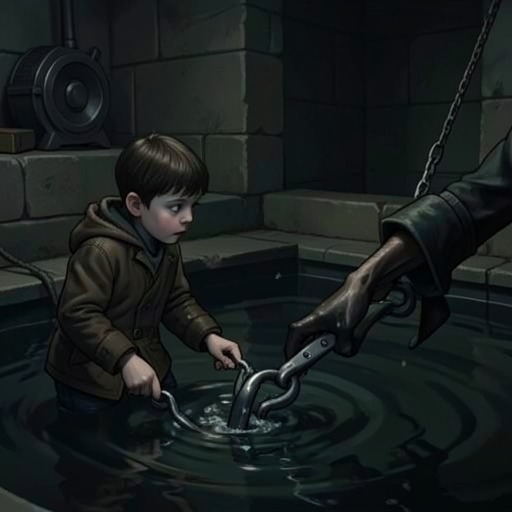
Eva's Near-Drowning
Handling the UndeadEva's Near-Drowning is a childhood crisis recalled years later by Sture, who tells David that seven-year-old Eva came close to drowning and encountered a creature beneath the water. The episode’s lasting significance lies not only in her survival, but in the name that resurfaces: the Fisher, a presence her family had understood through changing descriptions and a drawing that makes the child’s memory vivid without explaining it away.
The near-drowning and its aftermath
Sture remembers the danger as immediate and nearly fatal. He says Eva was seven and came very close to drowning; he blames himself for not watching her closely enough. Her mother knew exactly what to do, he says, and after the adults brought Eva back to life, Sture cannot easily continue the account. His broken recollection gives the event a clear human consequence—Eva survived because her mother acted—while leaving the precise circumstances of the rescue unstated.
The encounter did not become a full account at once. Several days after the near-drowning, Eva told her family that some kind of creature had been down there with her. David already knows a version of this story: Eva has described the being as the thing that came to take her, and has used the name Waterman. Sture adds that, when she was little, she called the creature the Fisher. The distinction matters to the later conversation: David has heard of the encounter, but not that childhood name.
Names, memory, and the surviving drawing
Sture says that, as Eva grew up, she usually called the creature the Waterman or simply That Thing. When she begins speaking of the Fisher again, he wonders whether she had forgotten the earlier name. The event therefore returns through a shift in vocabulary: a term from childhood reappears in Eva’s adult speech, prompting Sture and David to search through things she kept from her childhood. The recollection is not presented as a settled explanation of what happened; it is assembled from what Eva told her family, what Sture remembers, and what an old drawing preserves.
Sture recalls that the family encouraged Eva to draw the Fisher after the experience, thinking it might be good for her. Eva was already an able artist, and the surviving picture, dated July 1975, is the only one they find in the box of old papers. Sture checks beneath it for more drawings but finds none and says there used to be others. The single image is consequently an incomplete record: it offers a striking representation of the creature, but not a sequence of pictures that could clarify how Eva’s image changed.
The drawing places a smiling girl beside a figure at least three times her size. The creature has no face, only an empty oval, and its outline wavers as though it is changing, dissolving, or electric. Sture remembers Eva saying that the being was not clearly defined and seemed to change all the time. Against those uncertain contours, the hands are drawn with unusual precision: each finger ends in a large hook stretched toward the girl. David fixes on those hooks, while Sture explains that Eva said the creature had them to catch her, but was not fast enough. She also said the hooks were not really as large as they appeared in the drawing, though she had seen them clearly.
Survival, fear, and the image’s unresolved contrast
The picture refuses a simple visual equation between danger and terror. Its girl is smiling so broadly that the expression exceeds ordinary childhood conventions for drawing a face; Sture and David agree that she is smiling. The creature reaching toward her is enormous and faceless, yet the child’s expression is unmistakably happy. The contrast belongs to the surviving evidence rather than to any explanation Sture can supply: he can recount what Eva said about being caught, but he does not resolve why the drawn girl smiles.
The hooked hands make the threat specific. Sture connects the hooks to Eva’s account that the creature meant to catch her, and says she remembered it as too slow. He also recalls that the family fished often when Eva was young, but the conversation does not establish that fishing explains the creature or its hooks. The image instead holds together two kinds of detail: the figure’s body is unstable and indistinct, while the reaching hands are clear enough to remain fixed in David’s attention.
The event’s return in the present
The near-drowning enters the later scene because Eva is again talking about the Fisher. Sture recognizes the name and supplies the childhood history; the old drawing then gives David something concrete to examine alongside his wife’s present-day words. What had survived in fragments—a near-fatal accident, a report made days later, names that changed over time, and drawings made afterward—becomes a family investigation centered on one dated image.
The event remains unresolved in a precise way. Sture’s testimony confirms the danger, Eva’s childhood description of a creature, and her account of hooks that failed to catch her. The drawing preserves the creature as she represented it, including its shifting outline and reaching hands. Neither the recollection nor the picture establishes what the being was. Instead, the return of the name Fisher links Eva’s childhood encounter to her later speech, while the smiling figure in the drawing keeps survival and threat in the same frame.